Children's care

Guiding your child's jaw, airway, and breathing development from the very start.

When growth is still active, gentle, well-timed assessment can work with development rather than against it.

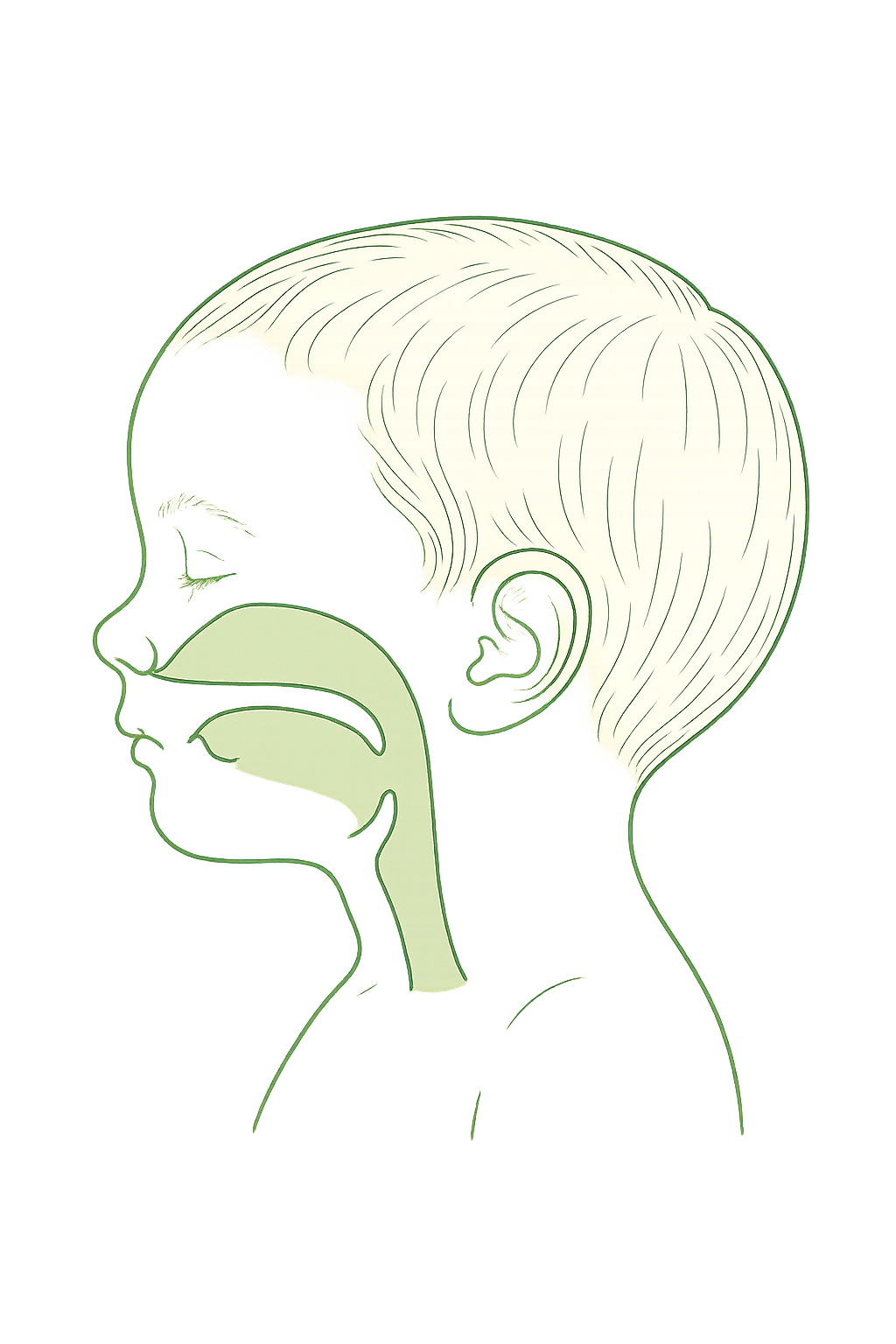
Line illustration of a child's head in profile with the nasal and pharyngeal airway highlighted
Fig. 01 Nasal and pharyngeal airway, highlighted
Why early matters

A child's face, jaw, and airway do not simply grow on a fixed schedule. They respond to function.

The way a child breathes, swallows, and holds their tongue at rest all shape how the bones of the face and jaw develop over time. This is not a permanent window, but it is a meaningful one. The years between ages four and twelve represent a period of significant skeletal plasticity, when gentle, well-timed intervention can work with natural growth rather than against it.

Breathing through the nose, with the tongue resting against the palate, encourages the upper jaw to widen and the airway to develop with adequate space. When that pattern is disrupted, by mouth breathing, a restricted tongue, or poor oral muscle function, the resulting structural changes can become increasingly difficult to address with age. Assessing how these systems are working together, early, can make a meaningful difference to the path ahead.

Signs to look for

Parents are often the first to notice something is off

Children rarely report breathing difficulties. Some signs can be subtle; others are easier to spot. Seen together, across three areas, they are worth assessing.

Breathing & sleep

  • Breathing through the mouth, particularly during sleep or at rest
  • Snoring, restless sleep, or waking frequently through the night

Teeth & jaw

  • Crowded, crooked, or irregularly spaced teeth as adult teeth come in
  • A narrow upper jaw or high, vaulted palate
  • A small lower jaw or recessed chin

Body & daytime

  • Forward head posture or rounded shoulders
  • Difficulty concentrating, irritability, or tiredness out of proportion to sleep hours
  • Slow or fussy eating, or a tendency to chew with the mouth open

None of these signs on their own confirms a problem, but together they can point toward patterns worth assessing properly.

Approaches to children's care

01

Early-stage orthodontics

Early-stage orthodontics, sometimes called interceptive orthodontics, is not about straightening teeth for appearance. It is about addressing the structural and functional conditions that are causing teeth to crowd or the bite to develop incorrectly in the first place.

Traditional orthodontic treatment typically begins in the early teenage years, once most of the adult teeth have come through. At that stage, the objective is usually alignment. Early-stage orthodontics begins considerably sooner, during the mixed dentition phase when baby and adult teeth coexist, with the aim of supporting healthier jaw development before the growth window narrows.

This can involve gentle palatal expansion, addressing tongue and lip function, and guiding the eruption of adult teeth into better positions. The forces used are light and gradual, working in keeping with how children's bones naturally respond to low-level, sustained pressure.

Before & after · drag to reveal

A narrow upper arch widening to a broad, well-formed arch after gentle expansion.

Same drag-to-reveal interaction as the home developmental section. Style: top-down arch, editorial line, sage. Pair narrow → broad.

02

Airway and breathing

Airway assessment at Growth and Airway goes beyond a visual examination. Using cone beam CT imaging where appropriate, it can be possible to evaluate the dimensions of the nasal and oral pharyngeal airway, identify potential obstructions such as enlarged tonsils or adenoids, and observe how tongue posture and oral muscle function are affecting available space.

The aim is to understand whether the airway is developing with enough room for healthy nasal breathing, and whether any structural or functional factors are interfering with that. Where relevant, this assessment connects with myofunctional therapy, breathing retraining, and, in some cases, referral to an ENT or other appropriate clinician.

Illustration only

A side-profile sagittal study of a child's airway, the nasal and pharyngeal passage drawn in sage.

Style: 19th-century engraving line, single deep-forest hairline, faces left. Companion to the hero illustration.

03

Invisalign First

Invisalign First is a clear aligner system designed specifically for younger children, typically between six and ten years of age. It can be used to gently widen the upper arch and create space for incoming adult teeth, without the need for fixed metal appliances.

For some children, Invisalign First can be a well-tolerated option, particularly where compliance is likely to be good. Like all orthodontic approaches, it works best when considered alongside the broader functional picture, including tongue function, breathing pattern, and oral muscle habits. Whether it is the right option for a given child is something that can be assessed properly at consultation.

Photography only

A young child holding a clear aligner, candid and at ease.

Style: 35mm documentary, natural light, real skin texture. Warm and content, never clinical or posed.

What to expect

An assessment, not a commitment to treatment

Parents leave the consultation with a genuine understanding of the situation, not a list of procedures.

01

A conversation

The first appointment typically includes a conversation about your child's sleep, breathing, eating habits, and medical history.

02

Clinical examination

A clinical examination of the teeth, jaw, bite, and oral muscle function follows, building a clear picture of what is and is not developing as expected.

03

Imaging where indicated

Where imaging is indicated, a cone beam CT scan can provide a three-dimensional view of the airway and facial structures.

04

Options in plain terms

Any options are explained in plain terms, so you leave with a genuine understanding of the situation rather than a list of procedures.

Common questions

Questions parents often ask

A few of the ones we hear most. The full list also covers adults, treatments, and practical details.

When should my child have their first visit?+

Early assessment can be valuable from around age five or six, when the first adult teeth begin to emerge and jaw development patterns become more apparent. That said, concerns at any age, including infancy, can be worth discussing with us.

What signs might suggest my child needs an assessment?+

Signs that can be worth exploring include: mouth breathing during the day or night, snoring, restless sleep, crowded or crooked teeth, a narrow jaw, difficulty chewing, prolonged thumb sucking, open mouth posture at rest, or speech difficulties. These are not guarantees of a problem, but they are worth looking at carefully.

Can children be too young for treatment?+

Not necessarily. Some functional concerns, including tongue and lip ties, can be relevant from infancy. Early myofunctional therapy and gentle orthodontic guidance can be appropriate for younger children when there is a clear functional reason to act.

What happens if my child's concerns are not addressed early?+

Jaw and airway development progresses most actively during childhood. Where structural and functional issues are present, leaving them unaddressed can mean more complex treatment is needed later. Children treated before the age of twelve to fourteen often achieve better structural correction than those treated in adulthood.

What does a child's assessment involve?+

We carry out a thorough review of bite alignment, jaw position, facial development, breathing patterns, tongue function, and posture. Where appropriate, we use cone beam CT imaging to assess nasal and oral airway dimensions. We also look at tonsil and adenoid size, tongue tie, and soft tissue tone.

My child snores. Is that normal?+

Snoring in children is common but not something to simply accept as normal. It can be a sign of airway resistance or paediatric obstructive sleep apnoea, both of which can affect sleep quality, behaviour, concentration, and development. An assessment can establish whether there is a structural or functional reason behind it.

See all FAQs →

Book a consultation for your child

If something has caught your attention, an assessment is the right next step.

Book a children's consultation with Growth and Airway.